
Searching Wasatch County Criminal Dockets
For a public Wasatch County criminal docket search, the starting point is Utah Courts Xchange. Pick District, Justice, or both as the jurisdiction. Then narrow to Wasatch County or a single named court. A bare number will not do. Utah case and citation numbers repeat across the state. A name hit needs checking before you trust it. Confirm the court, the case type, the filing date, and the party role.
Case parties have another option. MyCase is free. It requires identity and case verification, though, rather than an anonymous name lookup. When Xchange fails, an older case never fully converted, or you need an official copy, the public terminal and the clerk fill the gap.
- Choose District for a felony or Class A matter and Justice for most Class B, Class C, infraction, or traffic matters.
- Enter the case number with its court location, or begin with a last name and a careful wildcard.
- Narrow a broad result by county, court, case type, and relevant dates.
- Compare the case number, location, filing date, party code, and charge before opening the history.
- Save the identifiers and ask the maintaining clerk for certified or legacy records.
Wasatch Criminal Courts Split Work
Where the docket lives depends on criminal jurisdiction. The Utah Fourth District Court handles felonies and Class A matters. The Wasatch County Justice Court takes county Class B and C misdemeanors plus infractions. Heber City Justice Court covers municipal cases within its authority. Juvenile cases stay with Fourth District Juvenile Court. That court applies its own access rules.
| Matter | First court | Search point |
|---|---|---|
| Felony or Class A | Fourth District | District scope |
| County Class B/C or infraction | Wasatch Justice | Justice and county scope |
| Heber municipal case | Heber City Justice | Exact city court |
| Juvenile case | Fourth District Juvenile | Restricted by law |
One Wasatch County court coming up empty proves nothing about the others.
Inside a Wasatch Criminal Docket
A Wasatch County docket entry in Xchange can carry charges, agencies, citation data, the judge, attorneys, proceedings, due dates, account entries, pleas, dispositions, and linked public documents. The register is not the full file. A document can stay restricted even when its docket entry is open.
| Case number | A court identifier paired with its Wasatch County location. |
|---|---|
| Charge | An accusation, not proof of guilt. |
| Party code | A role such as defendant, witness, officer, or guardian ad litem. |
| Proceeding | A filing, setting, continuance, or completed hearing. |
| Plea | The recorded response to a charge. |
| Disposition | The resolution read with the judgment or sentence. |
| Financial line | A balance, fine, credit, fee, or due date that may change. |
Utah Courts publishes an official Xchange party-code reference for interpreting roles.
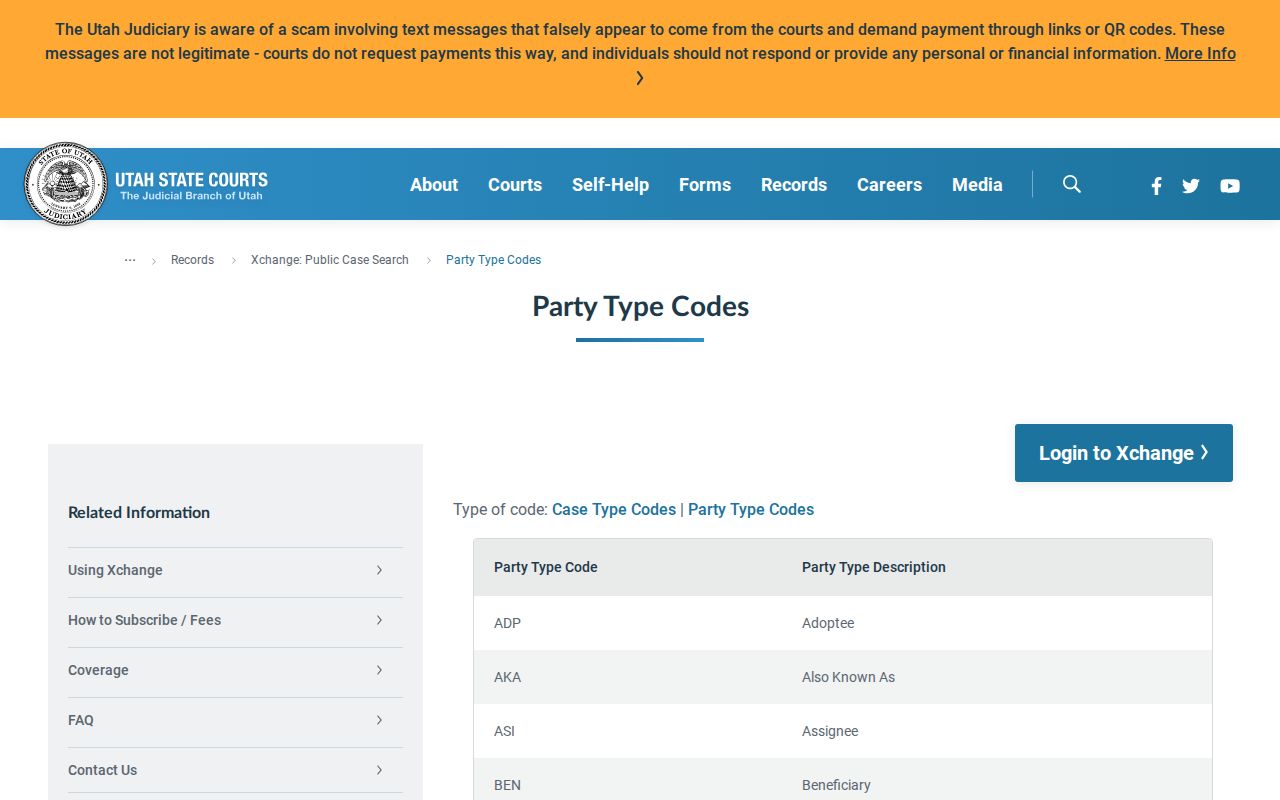
The reference separates a procedural role from what the proof or final order says.
Wasatch Charges Are Not Convictions
A Wasatch County criminal docket can show an accusation right after filing. That entry only reports what was alleged. It does not establish that the conduct occurred. Plea, disposition, judgment, and sentence sit in separate parts of the record, and each can attach to a different charge, so dismissal of one count says nothing about the rest.
Warrants and account lines need the same neutral reading. A warrant flag marks a procedural event, not a conviction. An unpaid balance can shift with credits, later orders, delinquency charges, or payment. A continued setting just means a date moved. Read the next entry and the final order.
- Charge
- An accusation entered in the case.
- Plea
- The defendant’s recorded response.
- Disposition
- How a charge was resolved.
- Judgment
- The court’s formal ruling.
How a Criminal Case Moves
A Wasatch County district criminal docket opens with a filed matter. It then logs each event in order. Justice court cases work the same way, even when the labels differ. Some end early. Others run through repeated settings, motions, plea changes, trial activity, and entries that come later.
Docket flow: Filing › Arraignment › Pretrial › Plea or Trial › Disposition › Sentencing
The initial appearance covers the charge, rights, release, and the plea process. Pretrial entries may record motions or negotiation. A plea alone never tells the whole result. Disposition and judgment complete the reading, and compliance, payment, appeal, or expungement entries can extend the Wasatch County criminal docket past sentencing.
Wasatch Clerks Correct Case Entries
Suspect an error? Contact the clerk of the filing court first. The Wasatch/Fourth District clerk's office sits at 1361 S Highway 40, Heber City, Utah 84032. It answers at 435-654-4676. Wasatch County Justice Court shares the highway address in Suite 100. Reach it at 435-654-2679 and jcwasatch@utcourts.gov.
Hand the clerk the full case number, the court location, and the entry in question. Staff can explain record access and the correction process. But they cannot simply change a judicial order. For a formal inspection or copy, use the Utah court-record request process. The court generally responds within ten business days, subject to the rules and scope.
Courts That Hold Criminal Dockets
No single countywide clerk holds the Wasatch County criminal docket. District, justice, municipal justice, and juvenile clerks each keep CORIS records for their own locations. A county attorney directory can help spot a venue. But it is not the case system. It never replaces the clerk.
Electronic filing plays a separate role. Attorneys file through Utah district eFiling, and eligible self-represented parties may file through MyCase. The official district eFiling rules spell out how that channel works.
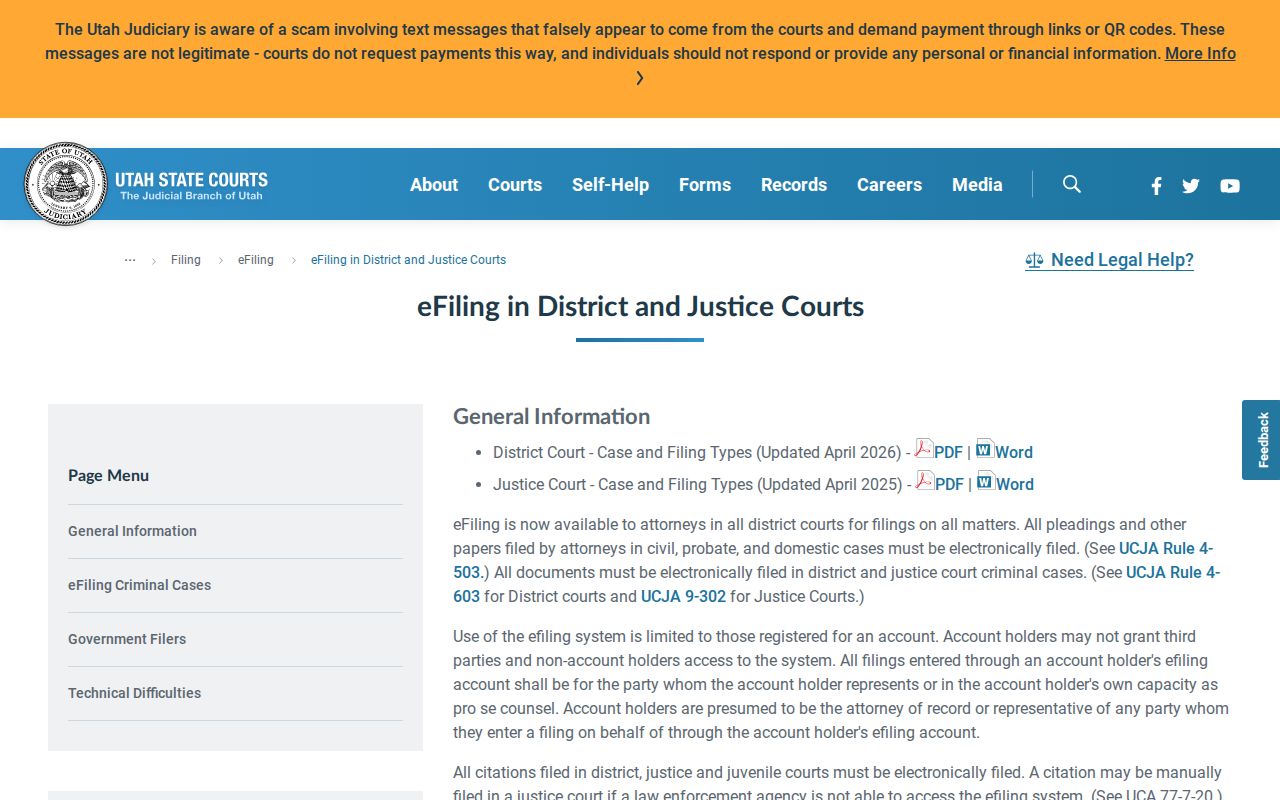
Filing through eFile does not make every document public on a Wasatch County criminal docket.
Wasatch Weekly Criminal Reports
The Utah weekly reports viewer posts public filing, disposition, and judgment reports each Monday. After a holiday, it posts them Tuesday. Each report lists location, case type, case number, dates, and party codes.
A weekly list is not a live Wasatch County criminal docket. It can miss a new setting. It can also miss a later filing, a nonpublic case, or any event outside that report type. Treat it as a way to grab official identifiers. Then confirm in Xchange or with the clerk. Private names appearing in a bulk report are not yours to reproduce.
Wasatch Citation Numbers Need Location
A citation number can unlock a Wasatch County criminal docket, at least in justice court. Xchange and ePayments both take citation details. One catch: you must attach the court location to the number. And a payment screen is just a payment screen. It is not the case history.
When nothing matches, confirm which court issued the ticket, then compare Wasatch County Justice Court against Heber City Justice Court. If a case number exists, try that instead. Parties can log into MyCase, while anyone else can use Xchange or call the clerk. A blank payment result is not a dismissal. The case could be pending in a different court, outside the searched date range, restricted from view, or filed under other identifiers.
Write down both numbers once you find them. The citation ties back to the ticket itself, and the case number anchors everything after it: pleas, settings, dispositions, and orders.
Sealed Dockets and Public Access
Access to sealed Wasatch County court records runs on Utah judicial rules plus whatever a court order says. UCJA Rule 4-202.02 sorts records into classes, Rule 4-202.03 sets out who may view what, and Rule 4-202.04 explains how to request access and review a denial.
Key access point: Xchange excludes sealed, expunged, juvenile, and other nonpublic classes. No result may mean restricted access, an older conversion gap, a wrong court, or a search mismatch.
An authorized party can work through MyCase or ask the clerk. The public cannot dodge those limits through another agency or terminal. Protected addresses, birth dates, medical facts, juvenile identities, and sealed details stay off limits.